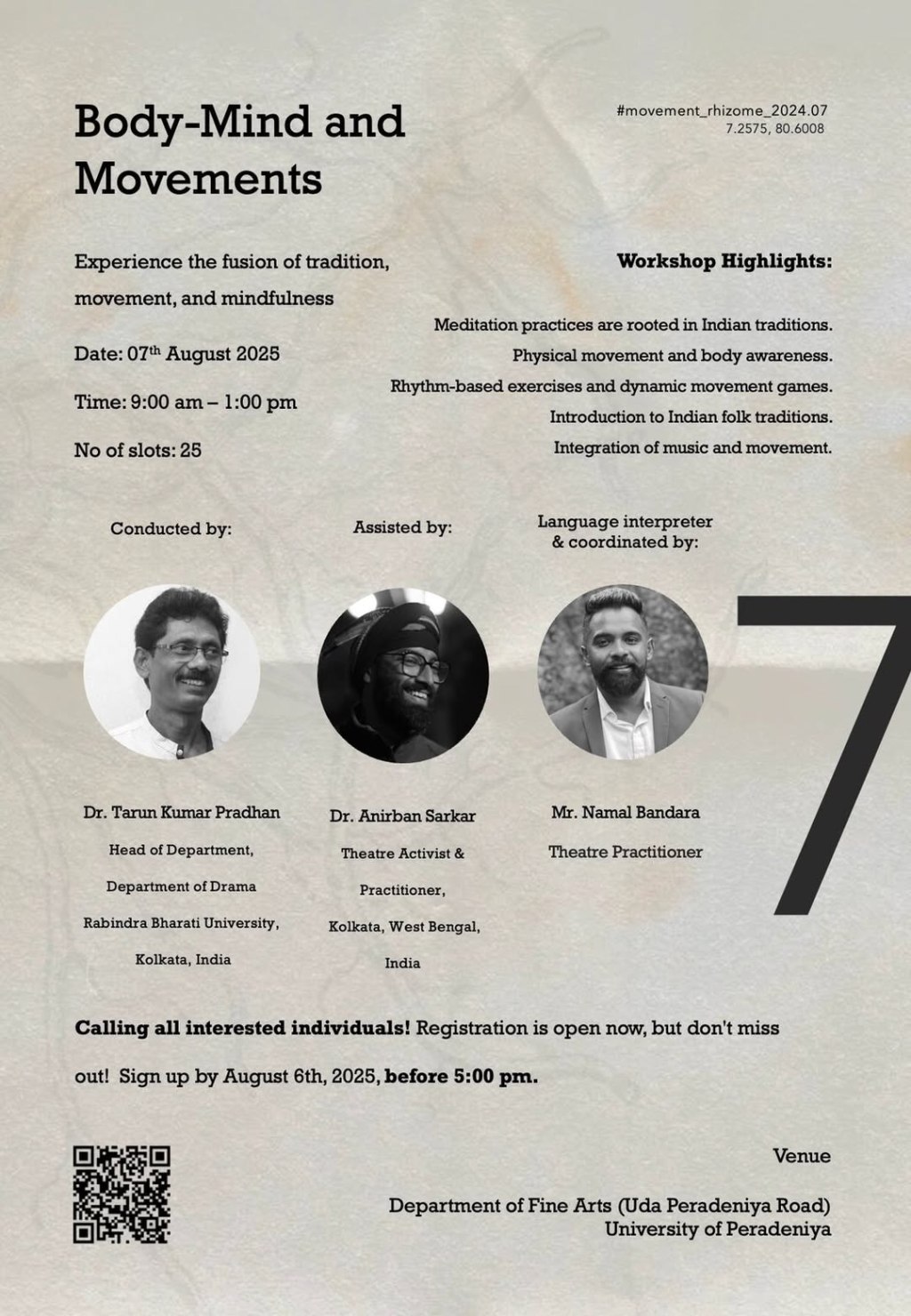
Body–Mind and Movements was a half-day experiential workshop held on 7 August 2025 at the Department of Fine Arts, University of Peradeniya. The workshop brought together meditation, movement, rhythm, and Indian folk traditions to explore the relationship between the body, mind, awareness, and artistic practice.
Led by Dr. Tarun Kumar Pradhan, Head of the Department of Drama, Rabindra Bharati University, Kolkata, India, and assisted by Dr. Anirban Sarkar, theatre activist and practitioner from Kolkata, the workshop created an immersive environment in which participants were encouraged to experience movement not simply as a performed action, but as a way of sensing, thinking, communicating, and connecting.
Through embodied exercises, rhythmic practices, meditation, and elements drawn from Indian folk traditions, participants explored how movement can emerge from attentive listening to the body. The workshop encouraged participants to become aware of breath, rhythm, gesture, space, presence, and the relationship between individual and collective movement.
Rather than separating the body from the mind, Body–Mind and Movements approached them as interconnected dimensions of experience. The workshop invited participants to consider how artistic knowledge can be developed through sensation and practice, and how movement can become a form of inquiry.
The workshop also became a space of cultural and artistic exchange. The encounter with Indian movement traditions was not approached simply as the transmission of a technique, but as an opportunity to encounter another way of understanding the body, rhythm, discipline, and collective practice.
The session was supported by Mr. Namal Bandara, theatre practitioner, who facilitated language interpretation and coordination, enabling participants and facilitators from different linguistic and cultural contexts to engage meaningfully with one another.
For Movement Rhizome, the workshop reflected a central belief: learning does not happen only through explanation. It happens through experience, through the body, through relationships, and through the spaces we create together.
Body–Mind and Movements therefore became more than a workshop. It became a shared exploration of how we move, how we listen, and how we become aware of ourselves and one another through movement.
A movement begins in the body, but it does not end there.