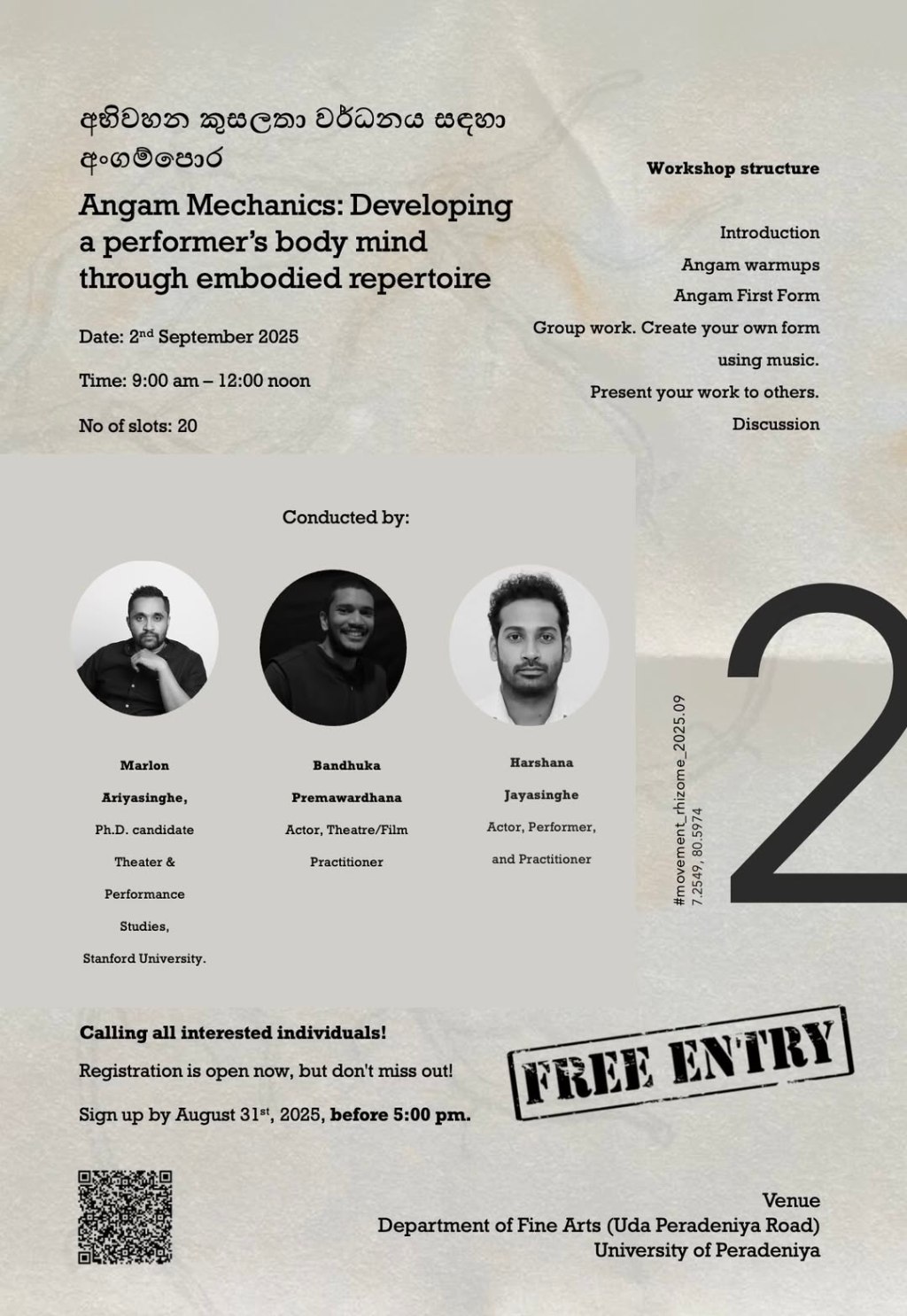
Angam Mechanics: Developing a Performer’s Body–Mind through Embodied Repertoire was an immersive practical workshop held on 2 September 2025 at the Department of Fine Arts, University of Peradeniya.
The workshop explored the possibilities of Angam-inspired movement as an embodied practice for performers, bringing together physical training, awareness, rhythm, creativity, and collective performance-making. Rather than approaching Angampora simply as a martial tradition to be observed or reproduced, the workshop invited participants to encounter its movement principles through the body and consider how these could open new pathways for contemporary performance practice.
The session began with an introduction to Angam and a series of Angam-based warm-up practices, allowing participants to gradually develop bodily awareness, coordination, rhythm, and readiness. Participants were then introduced to the Angam First Form, engaging directly with an embodied repertoire through repetition, observation, and practice.
The workshop then moved from learning towards collective creation. Working in groups, participants were invited to develop their own movement forms using music as a stimulus. This process shifted the workshop from receiving a repertoire to transforming and reinterpreting it. Through collaboration, participants experimented with how movement could be reorganised, composed, and performed in new ways.
The resulting group presentations became an important part of the learning process. Each creation demonstrated how an embodied vocabulary can change when it passes through different bodies, imaginations, rhythms, and relationships.
The workshop concluded with a discussion reflecting on the experiences of the participants and the possibilities of integrating embodied traditions into contemporary performance practices. Questions of body, discipline, memory, movement, transformation, and performance became part of the collective conversation.
The workshop was conducted by Marlon Ariyasinghe, Ph.D. Candidate in Theatre and Performance Studies at Stanford University; Bandhuka Premawardhana, actor and theatre/film practitioner; and Harshana Jayasinghe, actor, performer, and practitioner.
Within the broader practice of Movement Rhizome, Angam Mechanics opened another route for thinking about how knowledge is carried through the body. It demonstrated that embodied traditions can become sites of dialogue, experimentation, and transformation when approached through practice rather than treated only as objects of study.
The workshop asked participants not only “What do we know?”, but also:
How does the body know?
How does movement remember?
And what can happen when we create from what the body already carries?