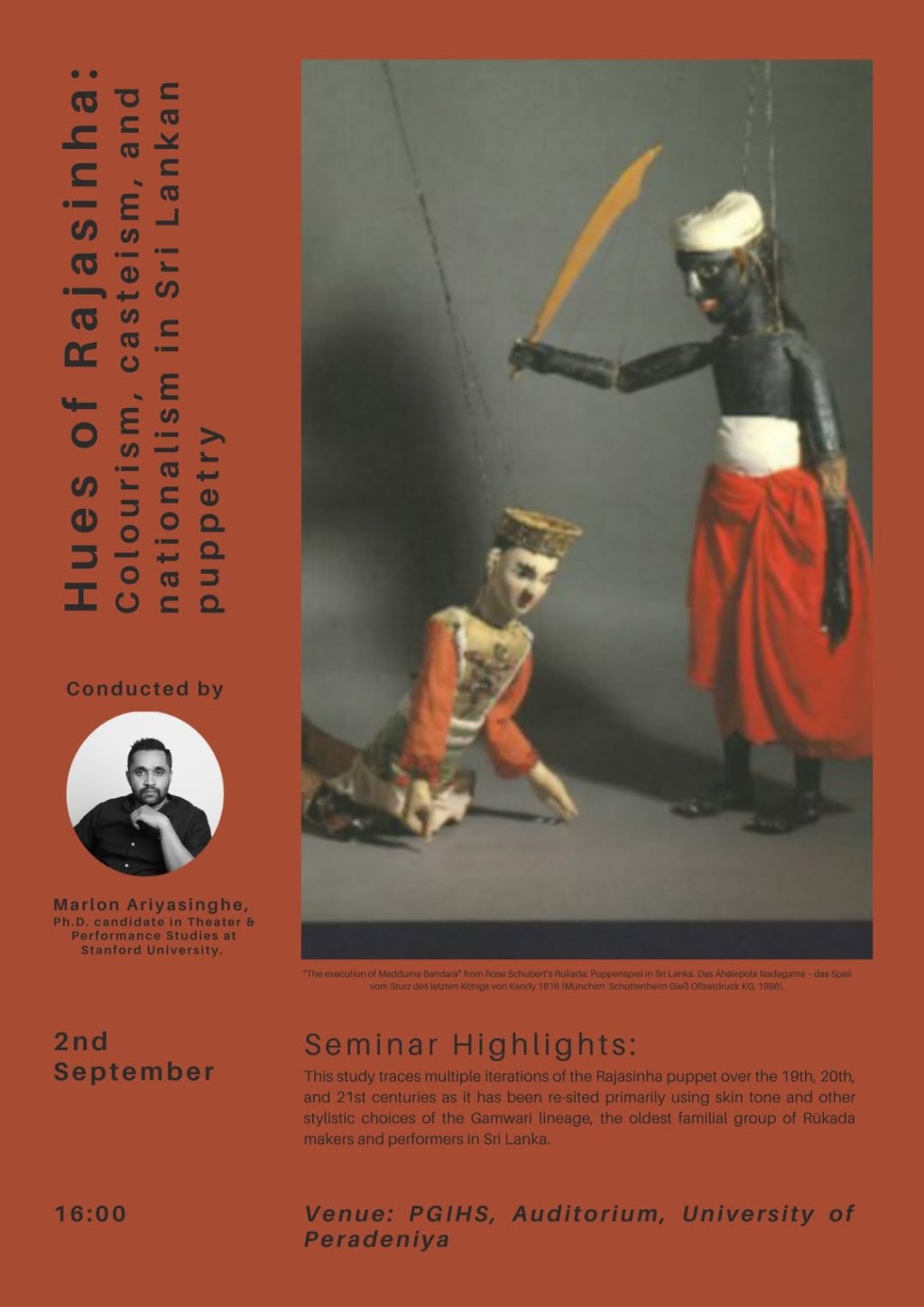
Hues of Rajasinha: Colourism, Casteism, and Nationalism in Sri Lankan Puppetry was a public lecture held on 2 September 2025 at the PGIHS Auditorium, University of Peradeniya. The lecture was conducted by Marlon Ariyasinghe, Ph.D. Candidate in Theatre and Performance Studies at Stanford University.
The session offered a critical exploration of the Rajasinha puppet and the ways in which its visual representation has changed across the nineteenth, twentieth, and twenty-first centuries. Rather than treating the puppet simply as an object of traditional craft or performance, the lecture approached it as a cultural form through which questions of race, skin colour, caste, identity, power, and nationalism can be examined.
Particular attention was given to the changing representation of Rajasinha through skin tone, colour, material choices, and stylistic conventions. These transformations opened questions about how cultural identities are constructed visually, and how seemingly familiar artistic decisions can carry histories of social hierarchy and political meaning.
The discussion also situated the Rajasinha puppet within the continuing practices of the Gamwari lineage, recognised as Sri Lanka’s oldest family lineage of Rūkada puppet makers and performers. By bringing the material history of puppetry into conversation with contemporary critical perspectives, the lecture encouraged participants to look beyond the surface of the puppet and consider the social histories embedded within its making and representation.
The event created a space to reflect on puppetry not merely as entertainment or heritage, but as a living cultural practicethrough which societies negotiate memory, identity, hierarchy, belonging, and national imagination.
For Movement Rhizome, the session extended the idea that artistic practice can become a way of asking difficult questions. A puppet can move, speak, and perform but it can also carry histories. Its colours, forms, materials, and changing appearances can reveal how ideas of identity are produced, reproduced, questioned, and transformed.
Hues of Rajasinha therefore invited participants to look again: at the puppet, at its history, and at the social worlds that are performed through it.